Some interesting reading
For a change, I'm sharing these in a reasonably timely fashion. I hope these are helpful. I thought it would be better to aggregate these rather than send separate emails if readers feel strongly that I shouldn't do this, let me know.
First off, the University of Notre Dame obtained an IMLS grant looking at a number of machine learning issues and held a really good focus group session (I was very grateful to be able to participate in some of this) prior to the pandemic. Eric Lease Morgan and his colleagues have now completed the outputs from this work, which are extensive and really valuable. With his permission, here's Eric's summary of the work and the outputs.
Goal - To understand the unique current practices of domain experts, librarians, and computer science specialists and to identify possibilities to use topic modeling and NLP to enhance or augment current library classification in order to meet current cross-disciplinary research needs
Findings: 1) Interest in machine learning is high and appears to be on a precipice, 2) The biggest issues with cross-disciplinary research are not discovery related, 3) There is a high need for interdisciplinary collaboration, 4) Community effort for greater ROI, 5) "Garbage in, garbage out,"; machine learning requires good data, 6) Ethics are a really big concern for machine learning, especially regarding bias, and 7) There is a need for greater machine learning literacy
Recommendations: 1) Increase the the community, 2) Develop machine learning education for scholars and library professionals, 3) Form learning communities and networks, 4) Create and curate a clearinghouse for machine learning models, 5) Support consortia around subject strength to develop machine learning tools, 6) Develop processes to enhance discovery tools, and 7) Support diversified machine learning innovations
As a bonus, we also published a freely available edited volume of fourteen essays on machine learning, entitled "Machine Learning, Libraries, and Cross-Disciplinary Research: Possibilities and Provocations". From the preface:
This collection of essays is the unexpected culmination of a 2018–2020 grant from the Institute of Museum and Library Services to the Hesburgh Libraries at the University of Notre Dame... The resulting essays cover a wide ground. Some present a practical, "how-to" approach to the machine learning process for those who wish to explore it at their own institutions. Others present individual projects, examining not just technical components or research findings, but also the social, financial, and political factors involved in working across departments (and in some cases, across the town/gown divide). Others still take a larger panoramic view of the ethics and opportunities of integrating machine learning with cross-disciplinary higher education, veering between optimistic and wary viewpoints.
For more detail and full access to the final report as well as the edited volume, please see:
- project home page - https://innovation.library.nd.edu/crossdisciplinary-research/
- final report - https://curate.nd.edu/show/7d278s48s11
- edited volume - https://curate.nd.edu/show/7h149p32226
Again, thank you for your participation!
-- Eric Morgan for Team IMLS Machine Learning Grant Hesburgh Libraries University of Notre Dame
Next, a very interesting report that looks at publishing patterns over time and what they suggest about evolving national roles in science and its communication. This was done by the Center for Security and Emerging Technology at Georgetown University. Curiously, I've not seen a lot of coverage or discussion of this report (though perhaps I'm just not paying attention to the right places). See
Research Security, Collaboration, and the Changing Map of Global R&D | Center for Security and Emerging Technology
The global map of research has shifted dramatically over the last 20 years. Annual global investment in research and development has tripled, and the United States’ share of both global R&D funding and total research output is diminishing. The open research system, with its expanding rates of investment and interconnectedness, has delivered tremendous benefits to many nations but also created new challenges for research integrity and security.
Also in the general area of research and national security issues, this is a useful piece that also comes out of the same group which relates to our work last year on Science Nationalism developments. See
https://www.lawfareblog.com/rethinking-research-securityThis is a paper that's just come out looking closely at how open science practices have evolved during the pandemic, focusing on COVID-19 research. We will need to see a lot more analysis of the issues raised here across various disciplines in the coming months. See
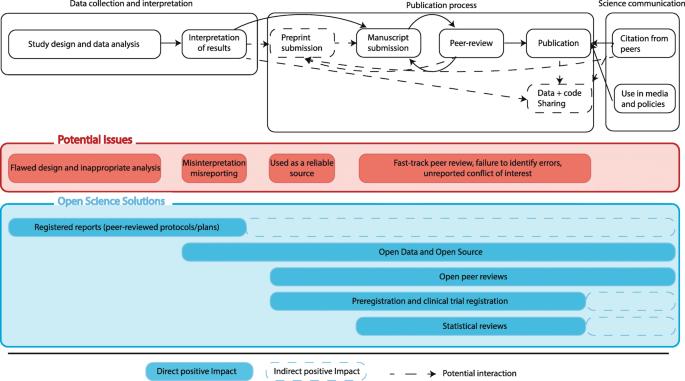
Open science saves lives: lessons from the COVID-19 pandemic | BMC Medical Research Methodology | Springer Nature Link
In the last decade Open Science principles have been successfully advocated for and are being slowly adopted in different research communities. In response to the COVID-19 pandemic many publishers and researchers have sped up their adoption of Open Science practices, sometimes embracing them fully and sometimes partially or in a sub-optimal manner. In this article, we express concerns about the violation of some of the Open Science principles and its potential impact on the quality of research o...
I've been tracking exemplars of possible post-PDF successors to the traditional scholarly paper for over 20 years; while there have been many of these, I don't think any have really seen adoption at scale. Here is a new set of examples released by eLife called "executable research articles" which are interesting because of their connection to the reproducibility and replicability movements in scholarship, and also because they use increasingly common and widely adopted tools. Here's the announcement and the pointers:
The collection follows the launch last year of new open-source ERA technology that lets eLife authors publish articles that treat live code and data as first-class citizens. This article format sets a new, open standard for the transparency, interactivity and reproducibility of published research. Authored with popular tools such as Jupyter Notebooks and R Markdown, ERA is available for all papers published in eLife.
Our collection showcases the breadth and variety of possibilities this new format offers, and you can view it at https://elifesciences.org/collections/d72819a9/executable-research-articles.
You can also read about the experiences of our first authors in an accompanying blog post, at https://elifesciences.org/labs/51777514/elife-authors-relay-their-experiences-with-executable-research-articles.
Finally, here's a link to a good piece from Steven Bell of Temple University that EDUCAUSE has just put out looking at what's happened to the relationship between library reserves and textbooks, largely (but certainly not entirely -- these trends were already well underway) as a result of the pandemic. See
https://er.educause.edu/articles/2021/1/farewell-print-textbook-reserves-a-covid-19-change-to-embraceClifford Lynch Director, CNI


